Quantize spacetime on your laptop.


CDT++ is the archival C++23 implementation of spherical 2+1-dimensional Causal Dynamical Triangulations.
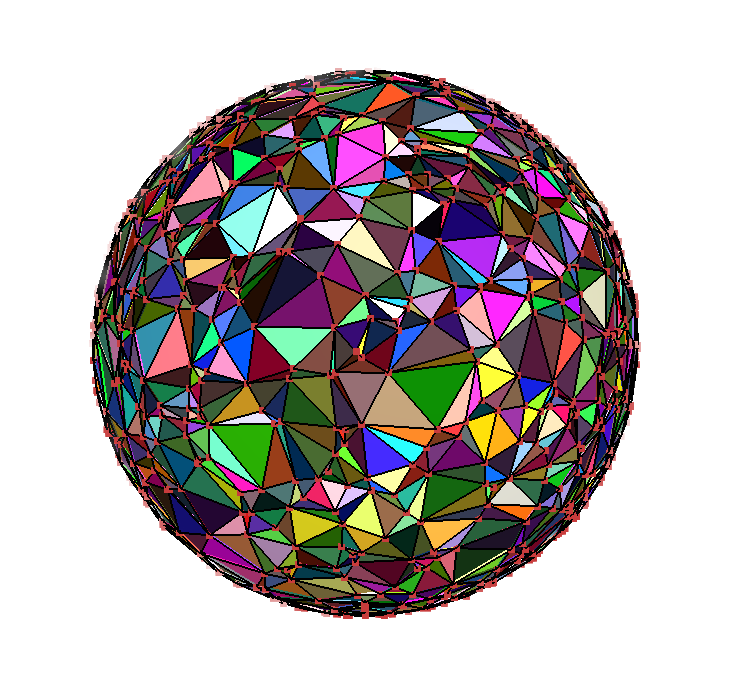
This reproducible archival rendering is generated from a tracked triangulation fixture; see the viewer and visual-artifact contract.
Maintenance status
CDT++ v1.0.0 is the final planned C++23 feature release. This repository preserves the C++ implementation as a historical scientific reference. After the release and Zenodo handoff in issue #97, it will remain maintenance-only during a stabilization window. Issue #155 will archive it only after the repository owner ends the stabilization window and determines that no release blockers remain. It does not accept new features or continued C++ development. Before archival, changes are limited to release-blocking correctness, reproducibility, security, documentation, and metadata corrections. A critical post-release defect requires a new patch release rather than changing the v1.0.0 tag.
For active use, development, and new reports, go to causal-triangulations, the supported Rust successor. See Security and support for the post-release reporting boundary.
Contents
- Introduction
- Features
- Quickstart
- Command-line usage
- Build requirements
- C++ API
- Release scope and limitations
- Reproducibility
- Documentation
- Visualization
- Citing CDT++
- Security and support
- Contributing
- License
Introduction
CDT++ is the archival C++23 implementation of spherical 2+1-dimensional Causal Dynamical Triangulations. The repository-wide REFERENCES.md provides the canonical bibliography for the scientific and algorithmic foundations used here.
The implementation uses the Computational Geometry Algorithms Library, Boost, and TBB. Arbitrary-precision numbers and functions are by MPFR and GMP. Melissa E. O'Neill's Permuted Congruential Generators library provides high-quality RNGs that pass L'Ecuyer's TestU01 statistical tests. {fmt} provides a safe and fast alternative to iostream, and spdlog provides fast, multithreaded logging. vcpkg provides library management and building, and Doxygen provides automated document generation. Python and JSON Schema provide the local, offline cross-implementation comparison boundary.
The primary cdt program generates and evolves spacetime ensembles. The initialize program produces initial foliated triangulations and supports the retained local parameter sweep. The opt-in cdt-viewer program renders tracked triangulations on macOS without adding Qt to the default headless build.
Features
- 3D simplex representation.
- 3D spherical triangulations with 2+1 foliation.
- S3 bulk action and the complete audited (2,3), (3,2), (2,6), (6,2), and (4,4) ergodic move set.
- 3D Metropolis-Hastings evolution with separate candidate-success and acceptance results.
- High-quality random number generation with M.E. O'Neill's PCG library and named replayable streams.
- Validated CDT++ .off persistence with provenance sidecars, payload checksums, geometry and topology fingerprints, and transition-trace fingerprints.
- Reusable initial-state generation: initialize writes a manifested triangulation that cdt --input validates and evolves with a new transition seed.
- Exact checkpoint continuation for interrupted Slurm and HPC runs: cdt --resume restores the triangulation, global pass, PCG state, transition trace, and cumulative counters, then continues the identical Markov chain on the recorded producer toolchain.
- A documented C++23 source API plus the headless cdt and initialize programs.
- Versioned, language-neutral reference fixtures and a lightweight local/offline C++/Rust comparison harness.
- Optional parallel triangulation with TBB for eligible CGAL Delaunay insertion and removal.
- Optional visualization with Qt and a reproducible repository-owned hero artifact.
- Cross-platform support on Linux, macOS, and Windows and cross-compiler support on GCC, Clang, AppleClang, and MSVC through the tested release matrix.
Quickstart
From a fresh checkout, the primary supported headless build, dependency bootstrap, and test path is:
The build recipe uses the Release configuration and the pkgx launcher on Unix when pkgx is available, then delegates to scripts/build.sh on Unix or scripts/build.bat on Windows. Its first run creates an ignored .cache/vcpkg checkout at the exact builtin-baseline recorded in vcpkg.json, bootstraps vcpkg, installs the manifest dependencies, builds in out/build/reference, and runs the supported CTest smoke suite. The first dependency build can take several minutes; subsequent runs reuse both vcpkg dependencies and CMake/Ninja outputs, so an unchanged build is a no-op apart from configuration and tests.
The supported build products are:
The underlying ./scripts/build.sh and scripts\build.bat entry points remain available for troubleshooting and native Windows use. Direct script invocations must expose CMake 4.4.0 or newer on PATH; the canonical pkgx-backed Just recipes select the tested 4.4.1 toolchain automatically.
Run just --list for the complete list of repository commands and their one-line descriptions. The primary user entry points are just initialize, just load, just resume, and just run.
Command-line usage
The supported build produces cdt and initialize in out/build/reference/src. Run either program through Just and pass its arguments after the recipe name:
For troubleshooting, the equivalent direct commands are ./out/build/reference/src/initialize --help and ./out/build/reference/src/cdt --help.
Run a simulation
The supported simulation surface is the spherical, three-dimensional form:
Use --no-output for batch, debugging, or scripted runs that should print results without writing checkpoint or final triangulation files:
Generate and load an initial triangulation
To generate an initial triangulation once and start a separate CDT run from that exact state:
Keep the generated .off and .off.meta files together. cdt --input verifies the pair, reconstructs the same initial causal triangulation, and starts a new Metropolis-Hastings transition stream from the second command's seed. It accepts only an initial-triangulation artifact from initialize; checkpoint and final artifacts cannot start a new chain through --input.
just load makes the new-series intent explicit. Its general equivalent is just run --input PATH; in both forms, cdt validates the manifest's artifact role rather than asking the Justfile to interpret persistence metadata.
Resume a checkpoint
To continue an interrupted run from a checkpoint, keep its .off and .off.meta files together and pass the payload to --resume:
The saved seed, action parameters, thread limit, checkpoint cadence, complete PCG state, transition trace, and cumulative move counters are restored. By default, the run continues to its originally configured total pass count. Use --passes TOTAL to extend that target; TOTAL is the global target, not a number of additional passes. Exact resume requires the same CDT++ source revision, compiler and standard library, build configuration and parallel feature, platform, and CGAL version that produced the checkpoint.
just resume makes the identical-continuation intent explicit. Its general equivalent is just run --resume PATH.
Generate many initial triangulations
For a collection of random starting states, give each seed its own directory so timestamped output names cannot collide:
The cross-executable initialize-to-cdt CTest exercises this handoff. The reference fixture package explains how the pair can serve as the input boundary for a future native causal-triangulations importer without treating the payload as generic mesh OFF.
Options and constraints
Run just run --help for the executable-owned option list and just run --version for the synchronized product version. Long options and their defined short forms are parsed by Boost.Program_options. The legacy parser still names toroidal topology and dimensionality, but runtime validation rejects toroidal input and every dimension other than three; they are not supported release modes.
--input cannot be combined with --spherical, --toroidal, --simplices, --timeslices, --dimensions, --init, or --foliate; those construction values come from the validated artifact. Action parameters, pass and checkpoint cadence, output control, thread limit, and the new run seed remain run-specific options.
--resume cannot be combined with replacements for the restored seed, action parameters, thread limit, and checkpoint cadence, or with topology and construction options. An explicitly supplied --passes TOTAL may retain or extend the global target; it cannot be less than the checkpoint's completed pass. Checkpoint numbering and cadence remain global across the interruption.
--threads is a maximum concurrency limit for CGAL/oneTBB bulk Delaunay operations. It defaults to 1. Zero and negative values are rejected. The canonical reference build accepts only 1; values greater than 1 require the parallel preset. This option does not parallelize Metropolis-Hastings, Pachner moves, persistence, or concurrent access to one manifold.
With --dimensions 3, every spatial slice is two-dimensional and the third dimension is the global time foliation. The accepted runtime boundary requires positive simplex and timeslice counts, finite physical parameters with alpha > 1/2, and a positive thread limit. Invalid configurations fail before construction.
With output enabled, every generated .off triangulation is accompanied by a .off.meta provenance manifest containing the effective seed, configuration, version/toolchain identity, transition-trace fingerprint, and payload checksum. Checkpoint manifests additionally preserve the exact transition-engine state and cumulative accounting needed by --resume; see docs/reproducibility.md for the resume, replay, and persistence contracts.
Build requirements
Tested release matrix
| CI cell | Host | Compiler | Standard library | Required contract |
|---|---|---|---|---|
| Ubuntu GCC | ubuntu-latest | GCC 16 | libstdc++ | just ci and just build-parallel |
| Ubuntu Clang | ubuntu-latest | Clang 22 | libstdc++ | just ci and just build-parallel |
| macOS AppleClang | macos-latest | Runner AppleClang | libc++ | just ci and just viewer-build |
| Windows MSVC | windows-latest, x64 | Runner MSVC | MSVC STL | just ci |
Linux compiler packages are pinned by the Justfile. The native macOS and Windows compilers follow the GitHub-hosted runner images, while CMake enforces the minimum C++23 floor: GCC 13.3, Clang 22, AppleClang 15, and MSVC 19.34. These are tested release cells, not a claim that every distribution, operating-system version, architecture, or compiler/standard-library pairing is supported.
Prerequisites
The smallest pkgx-assisted host setup is:
- Xcode Command Line Tools on macOS, or a C++23 compiler and base build environment on Linux
- pkgx
- Just, used by the recipes and scripts/pkgx-build.sh to resolve the repository's tool-version pins
- Python 3.14 for native dependency bootstrap, and uv when checking or running the Python support scripts
The pkgx build launcher supplies its required tools ephemerally, including Git, Bash, CMake, Ninja, Python, M4, Autoconf, Autoconf Archive, Automake, GNU Libtool, Texinfo, and pkg-config. If pkgx is not installed, provide these tools conventionally through a package manager such as Homebrew or apt. The build does not require a pre-existing personal vcpkg checkout, a fork, a submodule, Docker, or a hosted development environment.
On Windows, use an x64 Developer Command Prompt or Developer PowerShell for Visual Studio 2022 17.4 or newer, with MSVC 19.34 or newer available. Install Git for Windows and expose Git Bash on PATH, because the Just recipes use Bash. Native builds also require Just 1.58.0 or newer, Python 3.14 with python.exe on PATH, CMake 4.4.0 or newer, and Ninja. The tested Windows cell uses Python 3.14.6, CMake 4.4.1, and Ninja 1.13.0. Run just build from the repository root, or use scripts\build.bat reference directly; both bootstrap the repository-pinned vcpkg checkout.
Contributor validation, Debug and parallel builds, documentation generation, compiler caching, IDE setup, vcpkg maintenance, coverage, static analysis, and sanitizer workflows are documented in CONTRIBUTING.md.
C++ API
The supported C++ namespace and per-header contract are recorded in the C++ API boundary. CDT++ publishes a C++23 source boundary, not a stable binary ABI or package-registry distribution.
The compiled C++ API quickstart demonstrates validated construction, ten reported Metropolis proposals with separate candidate-success and acceptance results, aggregate accounting, and a verified persistence round trip. Build and run it with:
CGAL handles and facet or edge descriptors borrow from the exact triangulation that produced them. Do not use them with a copied triangulation or after an invalidating topology mutation. delaunay_snapshot() instead returns an owning, detached triangulation suitable for persistence or transfer across an ownership boundary. See the multithreaded CGAL contract for the full lifetime and synchronization policy.
Release scope and limitations
The v1.0.0 release supports one scientific model: spherical 2+1-dimensional CDT represented by three-dimensional foliated triangulations. It includes the complete audited (2,3), (3,2), (2,6), (6,2), and (4,4) move set, the Regge action, Metropolis-Hastings evolution, the headless cdt and initialize programs, deterministic reference fixtures, an offline C++/Rust comparison harness, and an opt-in macOS archival viewer.
The release boundary is intentionally narrow:
- Toroidal slices, dimensions other than three, and 3+1D/4D simulations are unsupported. The retained periodic and toroidal headers are historical prototypes under cdt::experimental, not public v1.0.0 APIs.
- Requested simplex counts drive a monotone spherical population heuristic; randomized post-repair counts are not an exact topology oracle or a calibrated phase-distribution result.
- A seed replays PCG inputs. Fresh cospherical CGAL construction can still choose another valid tetrahedralization, so exact fresh topology and cross-toolchain trajectory identity are not promised.
- Resumable checkpoints continue the identical Markov chain from a completed pass boundary only when loaded by the recorded CDT++ source revision and toolchain. They are restart artifacts, not portable interchange files.
- Optional oneTBB parallelism is limited to eligible CGAL Delaunay insertion and removal. Pachner moves, Metropolis-Hastings, persistence, and access to one manifold remain sequential and externally serialized.
- CDT++ publishes a C++23 source boundary, not a stable binary ABI or package-registry distribution.
The detailed evidence and failure boundaries are in the CGAL integration, ergodic-move, Metropolis-Hastings, reproducibility and persistence, and multithreading contracts.
Reproducibility
With output enabled, every generated .off triangulation is accompanied by a .off.meta provenance manifest containing the effective seed, configuration, version/toolchain identity, transition-trace fingerprint, and payload checksum. A run started with --input also records the source artifact's seed, initialization stream, placement fingerprint, and topology fingerprint. Resumable checkpoint manifests also contain the complete transition PCG state and cumulative move accounting. cdt --resume validates that state and the recorded producer contract before continuing. The scientific test suite compares an uninterrupted run with the same run split across checkpoint and resume, including the ordered transition trace, all move counters, and final canonical topology. Same-seed generation replays the random inputs, while exact transition replay requires an identical starting manifold; CDT++ does not alter its spherical construction to force CGAL to reproduce one of several valid cospherical tetrahedralizations.
The versioned, language-neutral fixtures, canonical C++ results, run manifests, raw outputs, and Rust consumption rules are published in the reference/ package. That package owns the detailed cross-implementation comparison and reference-fixture contract.
Documentation
Online documentation is at https://adamgetchell.org/CDT-plusplus/.
The compiled C++ API quickstart is the canonical end-to-end public API example and is embedded verbatim in the generated site.
- The complete supported public source surface is recorded in the C++ API boundary.
- The scientific transition, proposal-ratio, geometry-delta, counter, and precision contracts are recorded in docs/metropolis-hastings.md.
- The literature-backed contracts, exact deltas, inverse relationships, and failure-atomicity rules for the complete 2+1D move set are recorded in docs/ergodic-moves.md.
- Seed replay, PCG stream ownership, checkpoint metadata, and the parallel stream policy are recorded in docs/reproducibility.md.
- The exact CGAL version, kernel, triangulation data structure, metadata, lifetime, TBB, benchmark, and upgrade policies are recorded in docs/cgal-integration.md.
- The opt-in operations, ownership and synchronization rules, replayable stress inputs, sanitizer boundary, and matched scaling protocol are recorded in docs/multithreading.md.
- The initial-state interchange, cross-language comparison, local comparison harness, schemas, and raw archival records are documented in reference/README.md.
- The reproducible image, tracked fixture, and macOS renderer boundary are documented in docs/viewer.md.
- The repository-wide scientific bibliography is REFERENCES.md.
Documentation generation and validation are documented in CONTRIBUTING.md.
Visualization
The restored Qt-based cdt-viewer is an opt-in macOS archival renderer. Its tracked OFF fixture, render manifest, noninteractive smoke test, exact canonical-image policy, and inventory of historical visuals are documented in the viewer and visual-artifact contract. The default build remains headless and does not install Qt or Eigen.
Citing CDT++
If you use CDT++ in your work, please cite it using CITATION.cff. The papers and software on which CDT++ is based are collected in REFERENCES.md.
Security and support
CDT++ v1.0.0 is an archival scientific reference, not an actively maintained product. The reporting boundary for archive-specific vulnerabilities and issues that also affect the active successor is documented in SECURITY.md. Do not publish sensitive vulnerability details in the historical issue tracker.
Contributing
Active development has moved to causal-triangulations. Before CDT++ is archived, only release-blocking corrections within the maintenance-only stabilization scope are accepted. After archival, GitHub will make this repository read-only. See CONTRIBUTING.md for the correction scope, environment setup, developer commands, test and documentation validation, dependency maintenance, and pull request requirements. The preserved participation policy is in CODE_OF_CONDUCT.md.
License
CDT++ is distributed under the BSD 3-Clause License.
Generated by
 1.16.1