Dragons
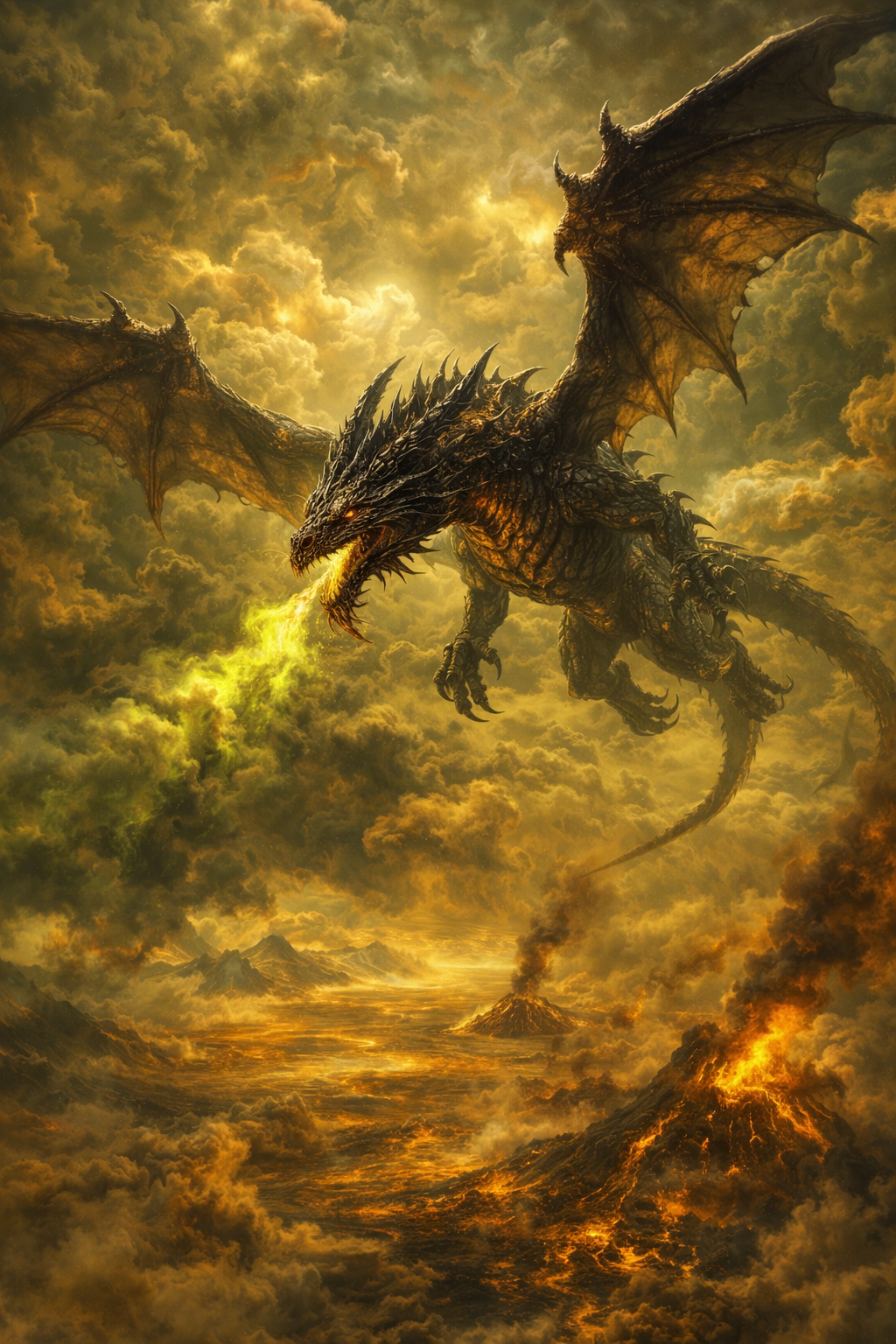
Dragons—known in ancient tongues as the Dracos—are among the most enduring and self-willed powers in existence. They are not merely apex predators of the sky, but living expressions of continuity, accumulation, and transformation. Where other beings are shaped by the world, Dragons reshape themselves across time.
They are vast, intelligent, and singular in purpose.
Origins Beyond Memory
In the earliest ages of Mundus, Dragons stood apart from the forces that sought to order and stabilize the world. They rejected imposed limits and predefined roles, choosing instead to pursue the fullest expression of their own potential.
Dragons believe that power is proven through endurance and growth. To persist is to justify existence. To accumulate is to refine the self.
This philosophy set them in direct opposition to the Giants, whose vision demanded hierarchy, constraint, and adherence to an original design.
Hoards and Continuity
A Dragon’s hoard is not mere greed. It is an extension of identity.
Artifacts, precious metals, and works of exceptional craftsmanship are gathered, curated, and preserved—not for commerce, but for continuity. Each hoard represents accumulated history, stored potential, and proof of survival across ages.
Gold and platinum are prized not only for rarity, but for their resistance to decay. Dragons value what endures.
Many an Elf, Dwarf, or Gnome has bargained for life or favor by offering works of lasting worth rather than transient wealth.
Lineage and Transformation
Dragons do not view lineage as ancestry alone, but as a mechanism of persistence. Bloodlines, drakes, and lesser kin are experiments in continuity—means by which a Dragon’s influence persists even as forms change.
Over time, Dragons transform. Size, breath, and temperament evolve. Some retreat into deep isolation, emerging only after centuries. Others fracture into variants shaped by environment, Mana saturation, or prolonged hoarding.
Change is not failure to a Dragon. Stagnation is.
Dragons in the Present Age
Dragons are few, but their presence warps the regions they inhabit.
They winter in established lairs and emerge during Springrise, when accumulated energy and hunger compel action. Vast herds vanish. Trade routes bend. Kingdoms negotiate or fall.
Dragons do not rule in the manner of kings. They exert gravity rather than authority.
Relationship to Magic and Mana
Dragons do not channel Mana as mortals do. Mana gathers around them naturally, drawn by scale, age, and accumulated presence.
- Mana pools within Dragon lairs without ritual.
- Blight is often tolerated, even exploited, as a catalyst for transformation.
- Dragons are resistant to Mana Burn, though excess instability may drive mutation rather than exhaustion.
Where Giants see failure, Dragons see opportunity.
The Long View
Dragons do not concern themselves with the immediate fate of Mundus. They measure time in epochs, not lifetimes.
Some legends suggest Dragons believe the world exists to be tested—stressed until only what can endure remains. Whether this philosophy represents wisdom or indifference remains debated by mortal scholars.
What is certain is this:
Dragons persist because they choose to.